Subject Matter & Problem
Nowadays, many daily human activities such as education,
trade, talks, etc. are done by using the Internet. In such things as
registration on Internet web sites, making comments, and other such activities,
hackers could develop programs that automatically register fictitious or
fraudulent users, add SPAM by abusing comments feature and thus interfere with
the proper functioning of publicly available Internet Web sites.
A common approach has been the deployment of CAPTCHA on Web
screens that require human interactivity.
A CAPTCHA is a type of challenge-response test used in computing as an
attempt to ensure that the response is generated by a human being. The process
usually involves a computer asking a user to complete a simple test which the
computer is able to grade. These tests are designed to be easy for a computer
to generate but difficult for a computer to solve, but again easy for a human.
If a correct solution is received, it can be presumed to have been entered by a
human.
A common type of CAPTCHA requires the user to type letters
and/or digits from a distorted image that appears on the screen. Such tests are
commonly used to prevent unwanted internet bots from accessing websites, since
a normal human can easily read a CAPTCHA, while the bot cannot process the
image letters and therefore, cannot answer properly, or at all.
The aim of this idea is the development of CAPTCAH for the users
familiar with the Arabic alphabet and scripts, using Arabic calligraphic styles
in languages such as Arabic, Kurdish, Pashtu, Persian, and Urdu languages.
Solution
The gist of this solution is to use the calligraphic styles
of Arabic script in a dual text CAPTCHA scheme.
Arabic calligraphy, also known as Islamic calligraphy, is
the artistic practice of handwriting, or calligraphy in the lands sharing a
common Islamic cultural heritage.
Broadly speaking, there are 2 styles of writing in Arabic Script:
Geometric Scripts and Cursive Scripts.
They are enumerated on the sections below together with sample writings
of each.
This naturally leads one to propose a dual CPATCHA scheme;
with one displaying geometric style scripts while the other one containing a
cursive style text. This gives the
possibility of creating 2 X 12 = 24 distinct pairs of CAPTCHA based on Arabic
calligraphic styles.
In order to supply the text for each of these 2 CAPTCHA
boxes, this idea relies on the methods and techniques of the references 1 &
2 for the following purposes:
The algorithms for distinguishing Arabic/Kurdish/Persian/Pashtu/Urdu
language users from computer programs is based on Arabic calligraphic styles of
text. The initial algorithm, discussed
in reference 1, is based on adding a background to the image of a meaningless
randomly generated Arabic/Kurdish/Pashtu/Persian/Urdu word. This method relies
on the difficulty of automatic separation of background from Arabic script text,
due to the presence of many diacritical dots and signs. Furthermore, in this
method, the image of a random meaningless Arabic/Kurdish/Pashtu/Persian/Urdu
text is shown to the user, and he is asked to type it. This algorithm is modified so that the
Arabic text is now written in a particular (Arabic) calligraphic style.
Furthermore, this idea relies on and extends the approach of
reference 2 for the generation of CAPTCHA test.
In that reference, instead of using a large database of prepared word
images written in Nastaliq calligraphic style, each time a random meaningless Arabic/Kurdish/Pashtu/Persian/Urdu
word is generated and shown to the user. Therefore, there is not a need to make
a local database for images. This
reduces the possibility of the text being recorded and over time the database
constructed by hackers through a process of massive search. In this disclosure, the above method is
extended so that the CAPTCHA word is in generated with a specific calligraphic
style.
This idea uses algorithms and techniques similar to those
found in reference 3 for the generation of CAPTCHA text. The algorithms are altered and extended to
include Arabic calligraphic styles.
(It should be noted that Arabic calligraphic style is not
identical with a font. There can be
multiple fonts within the same Arabic calligraphic style. For example, the German Gothic script and the
modern German scripts are not just distinguished by 2 different fonts; rather
they are different calligraphic styles within the Latin script.)
Considering that the presently available OCR programs cannot
identify these Arabic/Kurdish/Persian/Pashtu/Urdu words, the word can be
identified only by a user familiar with Arabic script as well as with the
specific Arabic calligraphic styles.
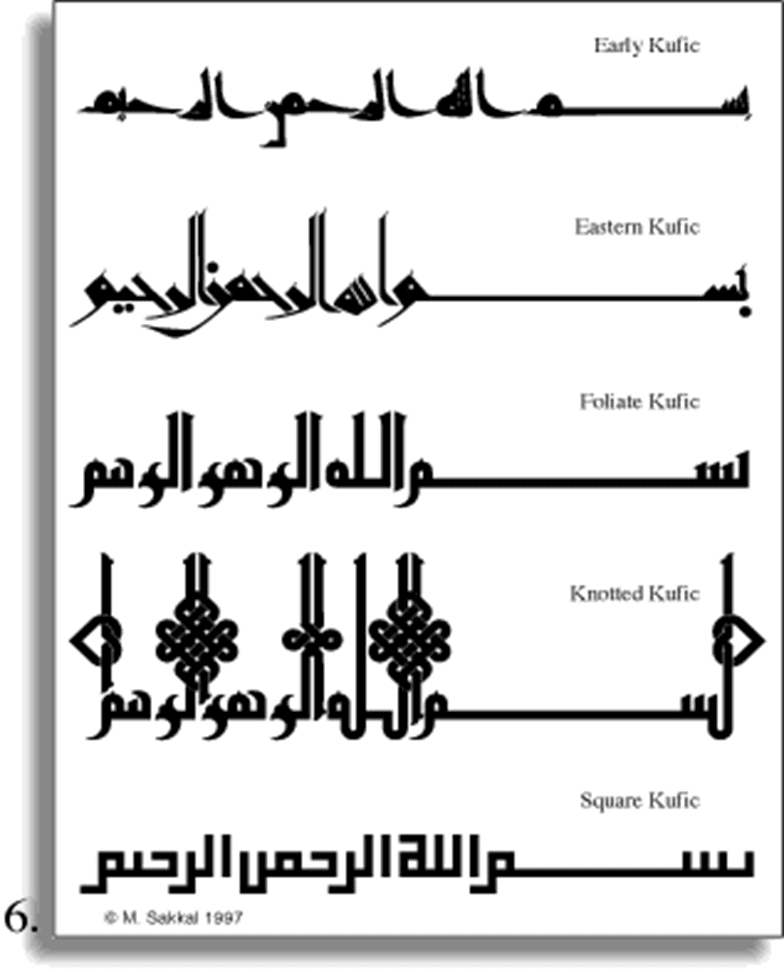
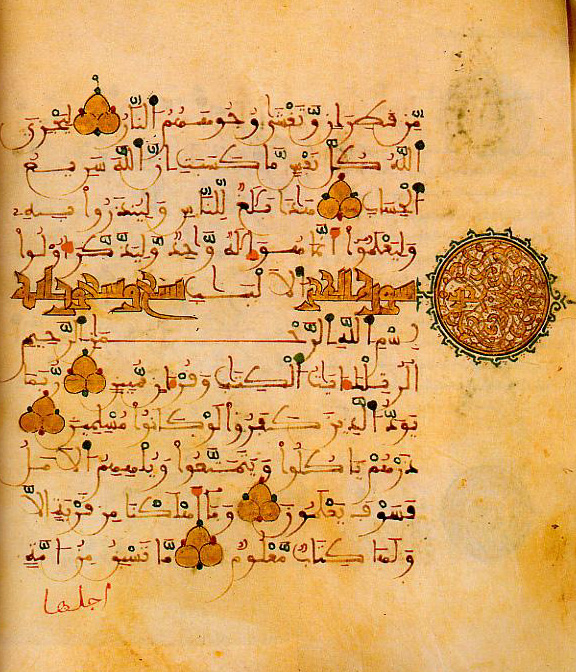
Geometric scripts
(basically Kufic styles)
Kufic is a cleaner, more geometric style, with a very
visible rhythm and a stress on horizontal lines. Vowels are sometimes noted as
red dots; consonants are distinguished with small dashes to make the texts more
readable.
and
The Maghribi script and its Andalusi variant are less rigid
versions of Kufic, with more curves.
In "Flowering Kufi", slender geometric lettering
is associated with stylized vegetal elements. In "Geometric Kufi",
the letters are arranged in complex, two-dimensional geometric patterns, for
example filling a square. This aims at decoration rather than readability.
Cursive styles (basically Naskh styles)
The cursive script styles are:
1.
Naskh is a simple cursive writing that was used in
correspondence before the calligraphers started using it for Qur'an writing. It
is slender and supple, without any particular emphasis, and highly readable. It
remains among the most widespread styles. The most famous calligrapher of this genre was Hâfiz Osman, an Ottoman calligrapher who lived during the 17th
century. It is the basis of modern Arabic print.
2.
Ṯuluṯ is a more monumental and energetic writing style,
with elongated verticals.
3.
Tawqīʿ appeared under the Abbassid caliphate, when it
was used to sign official acts. With elongated verticals and wide curves under
the writing line, it remained a little-used script.
and

4.
Riqaa' was a miniature version of tawqi'. It has
nothing to do with ruq`ah, a much later style the Ottomans developed for
secular handwriting, and which is still used at the present day in the Arab countries that fell within the Ottoman cultural sphere.
5.
Muḥaqqaq is an ample, alert script. Letter endings are
elongated, and their curves underline the text.
6.
Rayḥānī – which
is a miniature version of Muḥaqqaq.
7.
Nasta'liq is a cursive style that means
"suspended", which is a good description of the way each letter in a
word is suspended from the previous one, i.e. lower rather than on the same
level.
8.
Shikasteh
Nasta'liq (Broken Nasta'liq) is a variant of Nasta'liq used in Persian script and in more informal
contexts.
9.
Diwani script is
a cursive style of Arabic calligraphy that is distinguished by the complexity
of the line within the letter and the close juxtaposition of the letters within
the word.
and
Bihari script
(used in India during the 15-th century)
11 Ruq'ah (also
known as Riq'a) which is the most common script for everyday use is Simple and
easy to write, its movements are small, without much amplitude.
12 In China, a calligraphic form called Sini has been
developed. This form has evident influences from Chinese calligraphy, using a
horsehair brush instead of the standard reed pen
Use Case 1 – Normal User
The user navigates to a Web page that requires
validation. The Arabic Calligraphic
CAPTCHA Scheme will work with the Web server and display a dual Arabic text
strings to the user. Each CAPTCHA box
will display a randomly generated text based on Arabic script but in a
different calligraphic style. The
background of each CAPTCHA will also be different from each other.
The user, based on his knowledge and familiarity with Arabic
script as well Arabic Calligraphic styles will type the CAPTCHA texts in a text
box. If correct, the system will
validate/authenticate the user and the user will proceed with his tasks. If incorrect, the system will provide the
user with another set of CAPTCHA.
Use Case 2 – Administrative User
The system will be equipped with an administrative interface
and features. These administrative
features will enable the administrator to perform the following tasks:
1.
Add a new font to a style
2.
Remove font from a style
3.
Set the background of the CAPTCHA
4.
Set the length of the CAPTCAH text
5.
Set the size, color of the font for specific style to
be used or displayed
6.
Specialize the Arabic script to those of Arabic,
Pashtu, Persian, or Urdu
7.
Set the Arabic calligraphic styles of the dual CAPTCHA
scheme – including the ability of fixing the styles or making their choices
random.
Other Similar Solutions
This idea is based on
prior work sited below:
1.
Mohammad Hassan
Shirali-Shahreza, Mohammad Shirali-Shahreza: Persian/Arabic
Baffletext CAPTCHA. Journal of Universal Computer Science, vol. 12, no. 12
(2006), 1783-1796. (see http://www.jucs.org/jucs_12_12/persian_arabic_baffletext_captcha/jucs_12_12_1783_1796_shahreza.pdf )
2.
M. H. Shirali-Shahreza
and M. Shirali-Shahreza: Advanced Nastaliq CAPTCHA. Cybernetic Intelligent
Systems, 2008. CIS 2008. 7th IEEE International Conference on 9-10 Sept. 2008.
(see http://ieeexplore.ieee.org/xpl/login.jsp?tp=&arnumber=4798962&url=http%3A%2F%2Fieeexplore.ieee.org%2Fiel5%2F4786971%2F4798915%2F04798962.pdf%3Farnumber%3D4798962 )
3.
Bilal Khan, Khaled
Alghathbar, Muhammad
Khurram Khan, Abdullah M.
AlKelabi, Abdulaziz
AlAjaji: Cyber security using Arabic CAPTCHA scheme. Int. Arab J.
Inf. Technol. 10(1): 76-84 (2013) (see http://www.iajit.org/PDF/vol.10,no.1/3046-1.pdf )
The idea extends the
above works through the application of the Arabic calligraphic styles to the
CAPTCHA scheme.
The various styles may be realized in specific fonts
designed for that style. Within each
Arabic calligraphic styles, there could be numerous fonts that conform to the
stylistic rules of that style.
System Architecture & Design
The
architecturally significant components of the system are illustrated below:
Possible Modifications
This scheme may be extended to other Arabic calligraphic
artifacts for use in a CAPTCHA scheme:
1.
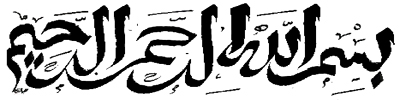
Bismillah Calligraphy
2.
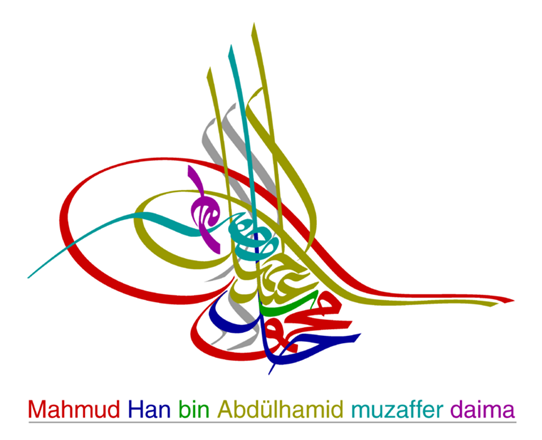
Tuqrah
3.
Zoomorphic Calligraphy