Showing posts with label 3-D Printing. Show all posts
Showing posts with label 3-D Printing. Show all posts
Wednesday, November 11, 2026


Sunday, August 30, 2026
Making Good: News of 3-D Printing
Zac Waters, 13, discovered 3D printing.
While watching a YouTube channel about his new passion, he also discovered MakeGood — a nonprofit which makes 3D-printed assistive devices.
He immediately got involved, spending his summer vacation designing, printing, and assembling a custom wheelchair for a 21-month-old girl. “It combines my two favorite things in life: 3D printing and helping people in need,” he said. “It just makes sense!”
The chair has pink accents — the girl’s favorite color — a cup holder, a tray table, and a space in back for medical equipment. It also includes a footrest and headrest that can be adjusted as she grows. “We hope he always remembers that the greatest legacy anyone can leave is to make someone else’s life better,” said Waters’ grandmother, Charlotte Waters. “His age does not define his ability to make a difference. His character does.”
(MS/KTVX Salt Lake City) ...That’s a lot more useful than fidget toys.
__________________________________________________________________________________________
Since 1994, this is the 1679th issue of Randy Cassingham’s...

16 August 2026: Western Union | Copyright ©2026 https://thisistrue.com |
Tuesday, January 20, 2026
Wednesday, January 1, 2025
Digital Holography for 3D Printing - A Proposal
In the absence of a CAD model for an object, a 3D printer
cannot produce a part. One approach has
been to use specialized video recorders to capture images of the object and
then extract a 3D CAD model from those images.
There could be issues with the tolerances of the generated 3D CAD model
with such devices.
Solution
In lieu of a CAD model of the object, a digital hologram of that object may be used. In digital holography the numerical reconstruction of object data is from the recorded measurement data, in distinction to an optical reconstruction which reproduces an aspect of the object. Digital holography typically delivers three-dimensional surface or optical thickness data. There are different techniques available in practice, depending on the intended purpose. See, for example, http://en.wikipedia.org/wiki/Digital_holography .
By recording the phase as well as intensity of light wave, holography allows reconstruction of the images of three-dimensional objects since the hologram contains all the information needed to reconstruct an image (real or virtual) of these objects in 3 dimensions. The conventional process of holography uses photographic plates. Note that in this approach to holography, real-time process is not feasible unless one uses photo-refractive and other nonlinear optical materials.
The first ingredient of this disclosure is the construction of a 360-degree digital hologram of an object. There are multiple known ways of creating a 360-degree hologram using a single reference beam such as Conical Denisyuk Holograms, Cylindrical Denisyuk Holograms, 360-degree Flat Holograms, 360-degree Transmission Holograms.
The key requirement for this disclosure is that the holographic interference pattern is digitally sampled by CCD/CMOS camera and the image is numerically reconstructed by applying the results from the diffraction theory. This is pre-existing art and various research teams have accomplished this task. Please see the http://www.springer.com/physics/optics+%26+lasers/book/978-0-387-31340-5 and the references therein.
There is another method, called Computer Generated Holography (CGH), for generating holographic interference patterns. In this method a holographic image can be generated; i.e. by digitally computing a holographic interference pattern from digitally captured images. This computed pattern can then be printed onto a mask or film for subsequent illumination by suitable coherent light source.
Both of these methods lead to the same outcome, the creation of a digital hologram.
These approaches to the construction of a digital hologram offers a number of significant advantages such as the ability to acquire the images rapidly, the availability of both the amplitude and the phase information of the optical field and the versatility of the processing techniques that can be applied to the complex field data.
Note that because in digital holography, the phase of the optical field, as well as the amplitude, results directly from the numerical diffraction of the optically recorded holographic interference pattern, one can have images of optical thickness profile with a precision of a fraction of a wavelength.
Now, the next step.
After the construction of the
digital hologram, it can be made to numerically interact with a numeric coherent
reference beam of using computer software and the theory of Wave Optics. That is, a 3D digital image of the object can
thus be created in the computer memory that contains both phase and intensity
information. This reconstructed digital image
can then be fed, via a suitable control mechanism, to the laser printer heads
of the 3D printer and guide the construction of the 3D part.
Possible Modifications
A different approach for using holograms in 3D printing is to forego the digitalization step all together and to capture 360-degree hologram of the object on holographic film.
Yet another approach is to record the digital hologram on holographic film and use the holographic film to create an image.
Either way, the next, using the reference beam and a converging lens, one can create a real image of the object in space within the 3D printer chamber. This is called a pseudoscopic 3D image; please see https://www.youtube.com/watch?x-yt-ts=1422327029&v=_Y9rmizlrg8&x-yt-cl=84838260
Printer heads, in this embodiment, like an ink-jet printer head, would spew out a suitable polymeric material. The jets would be directed at the location of the real pseudoscopic image that is created via the interaction of the laser reference beam and the hologram. The real image would then sinter the polymer material. Depending on the geometry of the 3D image, the printer-heads could move up-down or down-up.
Yet another approach is to record the digital hologram on
holographic film.
Wednesday, September 25, 2024
News of IBM (and AI)
https://www.theregister.com/2024/09/24/ibm_layoffs_ai_talent/
We read ""Senior software engineers stopped being developed in the US around 2012... No country on Earth is producing new coders faster than old ones retire. India and Brazil were the last countries and both stopped growing new devs circa 2023. China stopped growing new devs in 2020."
Yet no employers have been begging me to join their organization!
I must be missing something crucial.
Sunday, August 25, 2024
Analyzing Code with ChatGPT
I wonder if this approach could augment or replace such things as Profilers or (SQL) Execution Plans.
Friday, August 9, 2024
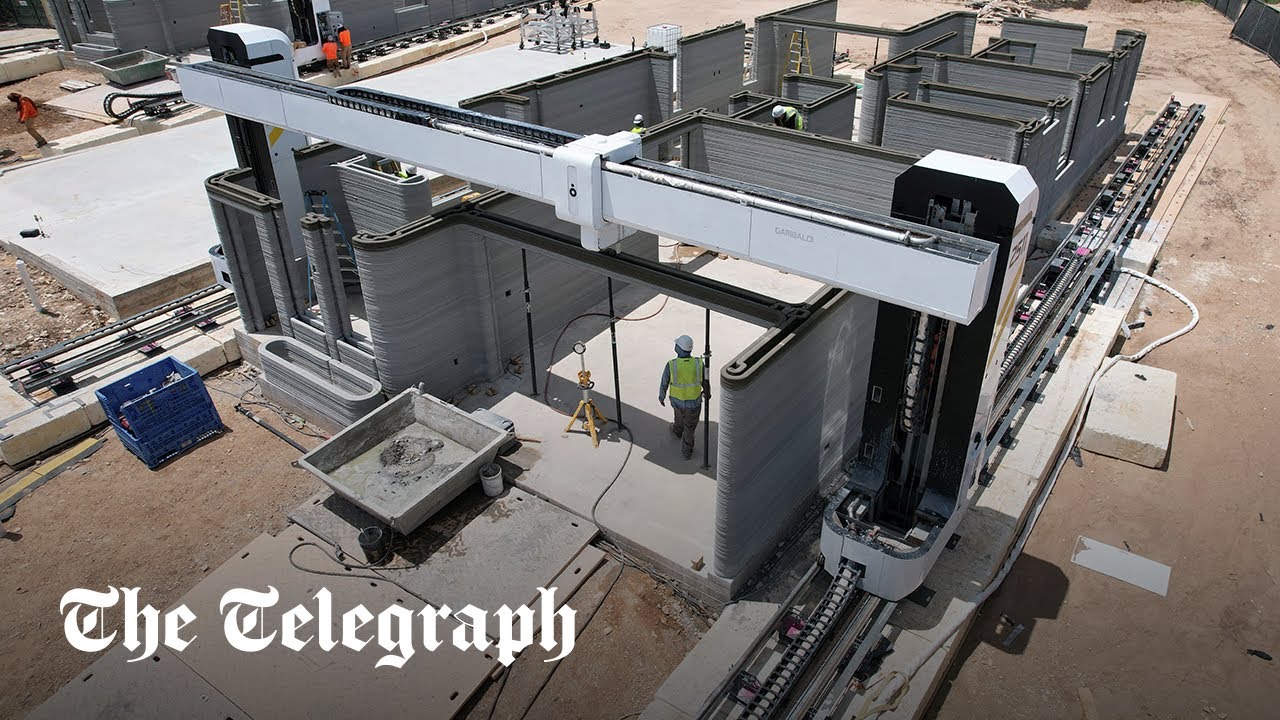
3D Printed Houses
From The Daily Telegraph of the UK
The walls of the houses are literally printed by a gigantic machine. (I have reproduced the article below, as it may be behind a pay wall.)
The finished product looks like a prefab house to me, but much sturdier, since the walls are made of concrete!...
___________
Watch: 3D-printer
completes final homes in world’s largest printed neighbourhood
Printing offers a
faster, cheaper and less wasteful way to build new housing
8 August 2024 •

In Texas, a towering
45ft robot is putting the finishing touches on what is thought to be the
world’s largest 3D-printed neighbourhood.
Icon, the developer
behind the project, is printing off its 100th house at Wolf Ranch in Georgetown
this summer, less than two years after kicking off the project.
It takes around three
weeks for work on each home to be completed.
Concrete powder, water,
sand and other additives are mixed together and pumped into a 4.75 tonne
printer called Vulcan.
The mixture is then
piped like icing through a nozzle along a pre-programmed path, layer-by-layer.
The resulting appearance of the walls is likened to corduroy.

Printing off homes in
this way is faster,
cheaper, requires fewer workers and minimises waste, according to the company.
Senior project manager
Conner Jenkins said: “It brings a lot of efficiency to the trade market. Where
there were maybe five different crews coming in to build a wall system, we now
have one crew and one robot delivering that scope. [There’s] the same advantages
for the supply chain system.
“We hope that as we
[consolidate] these different systems, we can bring down volatility in the
housing market.”
Printed homes at Wolf
Ranch are priced from around $450,000 (£353,510) to roughly $600,000. They
range from 1,500 to 2,000 sq ft and consist of either three or four bedrooms in
a single-storey floorplan.

Residents Lawrence
Nourzad and Angela Hontas, who bought a printed home at the ranch earlier this
summer, compared their new house to a “fortress”.
Mr Nourzad said the
walls are solid enough to “go head-on with maybe an F2, F3 tornado and be pretty resilient”. They were praised for keeping the
interior cool in the Texas heat, but criticised for causing connectivity
problems.
Mr Nourzad said: “These
are really strong, thick walls. That’s what provides a lot of value for us as
homeowners. But signal doesn’t transfer through these walls very well.”
The walls are designed
to be resistant to water, mould, termites and extreme weather.
While the walls are
printed, the foundation and metal roof are installed through traditional
construction methods.
For its next project,
Icon has been contracted by Nasa to built shelters and landing pads that are
suitable for the Moon’s surface.
_________
|
|
Watch: 3D-printer completes
final homes in world’s largest printed neighbourhood Printing offers a
faster, cheaper and less wasteful way to build new housing |
Monday, July 9, 2018
Monday, April 23, 2018
Printed Squid Drones
US Army Is Developing Stealthy 3-D Printed Squid Drones:
http://nationalinterest.org/blog/the-buzz/the-army-developing-stealthy-3d-printed-squid-drones-25498
Thursday, March 15, 2018
3-D Printed House
BBC -- Better than a garden shed
If it is an HP printer, you're going to need a lot of liquid-concrete cartridges, and they won't be cheap.
3D-printed home takes 48 hours to build
www.bbc.co.uk
It is hoped the technology can create better, cheaper homes for those who desperately need them.
Sunday, September 10, 2017


Wednesday, July 6, 2016
Weapon's Platform in Space
This is a weapon's platform in space - under the guise of asteroid mining with 3-D printers:
https://medium.com/made-in-space/how-we-want-to-turn-asteroids-into-spacecraft-e95d3214d787#.p0hen1605
Monday, August 24, 2015
Friday, July 11, 2014
Wednesday, December 11, 2013
News of 3-D Priniting
Wednesday, October 30, 2013
Monday, October 7, 2013
3-D Printing News
1.
eBay Unveils 3D Printing App:
2.
Applications
for Gradient Metal Alloys Fabricated Using Additive Manufacturing
Subscribe to:
Posts (Atom)
About Me

- Babak Makkinejad
- I had been a senior software developer working for HP and GM. I am interested in intelligent and scientific computing. I am passionate about computers as enablers for human imagination. The contents of this site are not in any way, shape, or form endorsed, approved, or otherwise authorized by HP, its subsidiaries, or its officers and shareholders.