The EU project “CyberWalk” developed an omni-directional treadmill, which together with markerless tracking, optimized control and several perceptual tricks enables humans to walk through Virtual Worlds in a natural and unconstrained fashion.
The platform consists of several belts which form an endless torus. The belts can be actuated and generate motion in one direction (X), the whole torus can rotate and generates motion in a second direction (Y). As the two motions can be controlled independently, any resulting motion can be generated to re-center a person.
The actual implementation offers 3.5 to 4.6 m of walking space and will be sized up to 5.5 times 4.6 m, speeding up to 2 m/s (person starts jogging).The platform can be easily sized up by its modularity. The theoretical span is almost unlimited by an innovative construction (patent pending). As size matters with regard to the maximum allowable accelerations on a human on the platform, this implementation can be considered as a breakthrough in the history of motion platform construction. Fields of application:
The "holodeck": The user is equipped with a Head Mounted Device (HMD) which shows the virtual reality. The HMD is tracked with a motion tracking system, on the one hand to generate the video data for the stereo vision of the HMD, on the other side to calculate the deviation of the user from the platforms center. This deviation is used to recenter the user. By respecting acceleration limitations and other restrictions, this process will not be noticed by the user. Many different applications are possible, from a walk to a new designed urban area to the research of an order picking process in an innovative environment.
Cyberwalk Project @ http://cyberwalk.kyb.tuebingen.mpg.de/
or @ http://www.amm.mw.tum.de/index.php?id=250
Thursday, April 17, 2008


AMD CTM
This is a free interface for interacting with AMD's GPU products (similar to NVDIA's CUDA). It is available @ http://ati.amd.com/companyinfo/researcher/resources.html
Sunday, April 13, 2008
Ascribing Mental States to Machines
This famous paper by John McCarthy may be found @ http://www.agent.ai/doc/upload/200406/mcca79_1.pdf
Web Sites of John McCarthy
I found these Web Sites by John McCarthy quite interesting:
John McCarthy's Home Page
PROGRESS AND ITS SUSTAINABILITY
John McCarthy's Home Page
PROGRESS AND ITS SUSTAINABILITY
Have You Abused XML Today?
The Common Business Communication Language (CBCL) is a proposal by John McCarthy that foreshadowed much of XML. The language consists of a basic framework of hierarchical markup derived from S-expressions, coupled with some general principles about use and extensibility. Although written in 1975, the proposal was not published until 1982, and to this day remains relatively obscure.
Here is a transaction in CBCL:
(REQUEST-QUOTE
(YOUR-STOCK-NUMBER A7305)
(UNITS 100)).
and in XML
<REQUEST-QUOTE>
<YOUR-STOCK-NUMBER> A7305 </YOUR-STOCK-NUMBER>
<UNITS> 100 </UNITS>
</REQUEST-QUOTE>
I do not see any benefit in the XML format, do you?
Here is a transaction in CBCL:
(REQUEST-QUOTE
(YOUR-STOCK-NUMBER A7305)
(UNITS 100)).
and in XML
<REQUEST-QUOTE>
<YOUR-STOCK-NUMBER> A7305 </YOUR-STOCK-NUMBER>
<UNITS> 100 </UNITS>
</REQUEST-QUOTE>
I do not see any benefit in the XML format, do you?
Friday, April 11, 2008


Thursday, April 10, 2008
NVIDIA Tesla C870
NVIDIA Tesla C870 is a Graphics Processor Unit (GPU) designed for high performance computing (HPC) solutions. It brings supercomputing power to any workstation or server and to standard, CPU-based server clusters.
Key elements include:
massively multi-threaded architecture with a 128-processor computing core
A C-language development environment for the GPU (called CUDA)
A suite of developer tools (C-compiler, debugger, performance profiler, optimized libraries)
Seamlessly fits into existing HPC environments
The CUDA programming guide is a good place to start. You can get it @ http://developer.nvidia.com/object/cuda.html
Then download the SDK. The sample code are a great learning resource.Also go through the UIUC course on parallel programming with special focus on CUDA @ http://courses.ece.uiuc.edu/ece498/al1/Syllabus.html
The SDK indicates simple ways to integrate C++ and CUDA
Key elements include:
massively multi-threaded architecture with a 128-processor computing core
A C-language development environment for the GPU (called CUDA)
A suite of developer tools (C-compiler, debugger, performance profiler, optimized libraries)
Seamlessly fits into existing HPC environments
The CUDA programming guide is a good place to start. You can get it @ http://developer.nvidia.com/object/cuda.html
Then download the SDK. The sample code are a great learning resource.Also go through the UIUC course on parallel programming with special focus on CUDA @ http://courses.ece.uiuc.edu/ece498/al1/Syllabus.html
The SDK indicates simple ways to integrate C++ and CUDA
Killer app for Groovy
Groovy (now in its 1.5 release) is a dynamic scripting language for the Java Platform. And Grails is the killer app for it.
Grails is an open-source, rapid web application development framework that provides a full-stack programming model based on the Groovy scripting language and built on top of Java EE, Spring, Hibernate, and the Quartz job-scheduling framework.
A free tutorial (.pdf file) called "Getting Started with Grails" by Jason Rudolf is available @ http://www.infoq.com/minibooks/grails but requires registration
Grails is an open-source, rapid web application development framework that provides a full-stack programming model based on the Groovy scripting language and built on top of Java EE, Spring, Hibernate, and the Quartz job-scheduling framework.
A free tutorial (.pdf file) called "Getting Started with Grails" by Jason Rudolf is available @ http://www.infoq.com/minibooks/grails but requires registration
Supporting Multiple Dispatch in C++
Bjarne Stroustrup on how to cleanly add multiple dispatch to C++:
http://www.research.att.com/~bs/multimethods.pdf
Dylan and CLOS already do so.
http://www.research.att.com/~bs/multimethods.pdf
Dylan and CLOS already do so.
2 From Microsoft Research
From Microsoft Research:
"The Influence of Organizational Structure On Software Quality" @
http://research.microsoft.com/research/pubs/view.aspx?tr_id=1425
And
"Low-level Software Security: Attacks and Defenses" @
http://research.microsoft.com/research/pubs/view.aspx?type=Technical%20Report&id=1396
"The Influence of Organizational Structure On Software Quality" @
http://research.microsoft.com/research/pubs/view.aspx?tr_id=1425
And
"Low-level Software Security: Attacks and Defenses" @
http://research.microsoft.com/research/pubs/view.aspx?type=Technical%20Report&id=1396
Wednesday, April 9, 2008
Holes
Bingham Canyon Mine, Utah


Great Blue Hole , Belize


Mirny Diamond Mine , Serbia


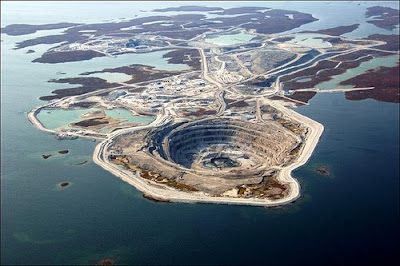
Diavik Mine, Canada

Sinkhole in Guatemala


Kimberley Big Hole - South Africa


Glory Hole - Monticello Dam, California


Great Blue Hole , Belize


Mirny Diamond Mine , Serbia


Diavik Mine, Canada


Sinkhole in Guatemala


Kimberley Big Hole - South Africa


Glory Hole - Monticello Dam, California


Tuesday, April 8, 2008
Free LabVIEW Toolkit for LEGO® MINDSTORMS® NXT
You can program your LEGO MINDSTORMS NXT using NI LabVIEW @ http://zone.ni.com/devzone/cda/tut/p/id/4435.
If you are not a current LabVIEW user you can get a free, Student Edition, @ http://digital.ni.com/express.nsf/bycode/lvtoolkitlego.
If you are not a current LabVIEW user you can get a free, Student Edition, @ http://digital.ni.com/express.nsf/bycode/lvtoolkitlego.
JAUS
JAUS stands for Joint Architecture for Unmanned Systems. JAUS is a component based message passing architecture that defines a data format and methods of communication between computing nodes.
In order to ensure that the architecture is applicable to the entire domain of current and future unmanned systems, it is built on the five principles of – vehicle platform independence, mission isolation, computer hardware independence, technology independence and operator use independence.
Learn more about it @
http://en.wikipedia.org/wiki/JAUS
and
http://www.jauswg.org/
In order to ensure that the architecture is applicable to the entire domain of current and future unmanned systems, it is built on the five principles of – vehicle platform independence, mission isolation, computer hardware independence, technology independence and operator use independence.
Learn more about it @
http://en.wikipedia.org/wiki/JAUS
and
http://www.jauswg.org/
Sunday, April 6, 2008
.Net Micro Framework
A short introduction to the .Net Micro Framework @ http://blogs.msdn.com/netmfteam/archive/2007/11/12/building-a-thermostat-with-the-microsoft-net-micro-framework.aspx
with more @ http://www.sjjmicro.com/SJJ_Articles.html
with more @ http://www.sjjmicro.com/SJJ_Articles.html
Friday, April 4, 2008
Tuesday, April 1, 2008
Free Virtualization Products
VirtualBox runs on Windows, Linux, and Macintosh Hosts and can run Windows Vista, Windows XP, Windows 200, Windows NT, and many Linux flavors as guests. It is available @ http://www.virtualbox.org/
VirtualBox uses the free (but not open-source) processor emulator QEMU. It provides system emulation for Windows, DOS, Linux, and BSD. It is available @ http://fabrice.bellard.free.fr/qemu/
VirtualBox uses the free (but not open-source) processor emulator QEMU. It provides system emulation for Windows, DOS, Linux, and BSD. It is available @ http://fabrice.bellard.free.fr/qemu/
Subscribe to:
Posts (Atom)
About Me

- Babak Makkinejad
- I had been a senior software developer working for HP and GM. I am interested in intelligent and scientific computing. I am passionate about computers as enablers for human imagination. The contents of this site are not in any way, shape, or form endorsed, approved, or otherwise authorized by HP, its subsidiaries, or its officers and shareholders.