A site devoted mostly to everything related to Information Technology under the sun - among other things.

Friday, August 23, 2024

Data Monetization Estimation


William Thomson, Lord Kelvin

"When you can measure what you are speaking about, and express it in numbers, you know something about it, when you cannot express it in numbers, your knowledge is of a meager and unsatisfactory kind; it may be the beginning of knowledge, but you have scarcely, in your thoughts advanced to the stage of science.”

Lecture on "Electrical Units of Measurement" (3 May 1883), published in Popular Lectures Vol. I, p. 73

Estimating Data Value

Introduction

There has been a lot of interest in data monetization over the last decade or so and this discussion is meant as a way of thinking about estimating the potential value of data and in contradistinction to realization of that value.  Think of this as an analogue of a geological survey without any guarantee of finding economically viable mines; an attempt at a quantitative analysis of what value data have along the lines that the late Lord Kelvin had suggested.

Column Value Model

We assume a company’s value to be a combination of human, physical, and data capital; a fully automated company with no human resources is a pipedream, a company must have physical assets to conduct business (be they rented) and must make decisions based on some information or other.  (For simplicity, Goodwill valuation is excluded from this model).

So we start with the following formula for the company’s valuation and the proceed to give an estimate of its data assets in a more defined manner.

            Company Valuation = Human Capital + Physical Capital + Data Capital

Assume all three parts have the same value and the company’s valuation is $ 3 billion:

               Data Capital = Company Valuation/3 = $ 1 Billion

In this model, we would like to estimate the average value of each column of data in all the relational schemas that the company uses, i.e.


Let us further assume that there are 50 relational schemas in this company, that they each have 50 tables of 20 columns each.  This gives a total of 50,000 columns in total that yields an average value of $ 20,000 per column.  In this approach, all columns are considered to be of equal value; be they customer names (let us say) or such ubiquitous columns as “Last Updated Date”.

We can then proceed to estimate an Average value for each Schema


In this discussion, since all schema are assumed to be identical in the number of tables and columns, their average data value is $ 20 million.  However, in practice, there are different schema and each is different from the other and this type of model serves to identify the most valuable schema that a company has.

Alternative Models

Data Volume Model

In this model, the value of each schema is estimated based on its data volume.  That is:


The total Data Valuation will be divided by this number, an average value per Gigabyte is extracted, and the value of each schema is then computed by multiplying its data volume by that average number. 

Time Dependent Model

Another model is one with time-dependent variable weights for value of each part of the company’s valuation, i.e.:

 Valuation = h(t) Human Capital + p(t) Physical Capital + d(t) Data Capital

With constrains:

h(t) + p(t) + d(t) = 1 and h(t) ≥ 0, p(t) ≥ 0, d(t) ≥ 0

Weighted Schema Model

In this model, we are capturing the importance of each schema – via the factor a(n) – and the historical data volume available for each Schema by the second sum and the factor b(m). 

The exp(1-m) is intended to model the aging and staleness of the data.


LinkedIn Analysis of Tech Job Trends

https://www.linkedin.com/pulse/i-spent-8-weeks-researching-2024-tech-job-market-colin-lernell-v2kic#:~:text=The%20market%20is%20still%20tight,2023%2C%20the%20competition%20is%20fierce.

Friday, August 9, 2024

3D Printed Houses

 From The Daily Telegraph of the UK

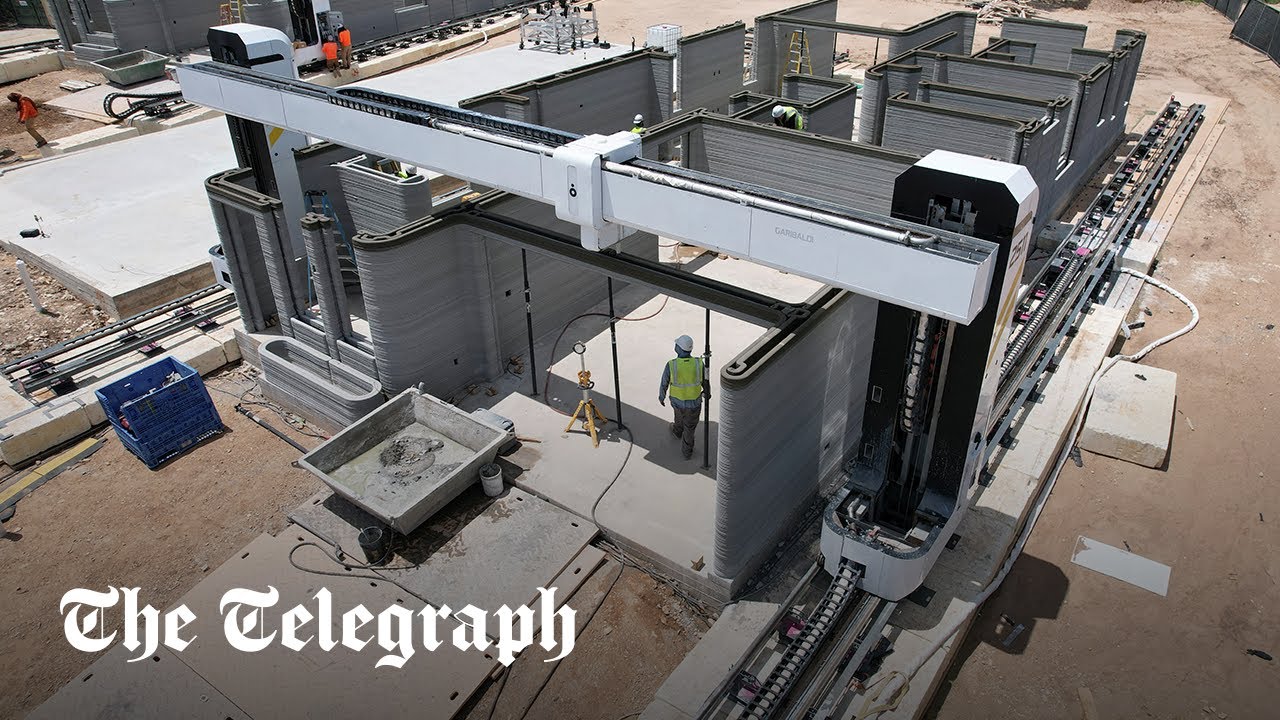
The walls of the houses are literally printed by a gigantic machine. (I have reproduced the article below, as it may be behind a pay wall.) 

The finished product looks like a prefab house to me, but much sturdier, since the walls are made of concrete!... 

___________

Watch: 3D-printer completes final homes in world’s largest printed neighbourhood

Printing offers a faster, cheaper and less wasteful way to build new housing

Pui-Guan Man

8 August 2024 • 

tmg.video.placeholder.alt wLoV8JwDxzw

In Texas, a towering 45ft robot is putting the finishing touches on what is thought to be the world’s largest 3D-printed neighbourhood. 

Icon, the developer behind the project, is printing off its 100th house at Wolf Ranch in Georgetown this summer, less than two years after kicking off the project.

It takes around three weeks for work on each home to be completed.

Concrete powder, water, sand and other additives are mixed together and pumped into a 4.75 tonne printer called Vulcan. 

The mixture is then piped like icing through a nozzle along a pre-programmed path, layer-by-layer. The resulting appearance of the walls is likened to corduroy.

ICON print captain Rogelio Serrano monitors a Vulcan 3D printer printing the walls of a home

The Vulcan 3D printer layers building material into a pre-programmed pattern Credit: REUTERS/Evan Garcia

Printing off homes in this way is faster, cheaper, requires fewer workers and minimises waste, according to the company.

Senior project manager Conner Jenkins said: “It brings a lot of efficiency to the trade market. Where there were maybe five different crews coming in to build a wall system, we now have one crew and one robot delivering that scope. [There’s] the same advantages for the supply chain system.

“We hope that as we [consolidate] these different systems, we can bring down volatility in the housing market.” 

Printed homes at Wolf Ranch are priced from around $450,000 (£353,510) to roughly $600,000. They range from 1,500 to 2,000 sq ft and consist of either three or four bedrooms in a single-storey floorplan.

Wolf Ranch community in Georgetown

The 100th 3D-printed home is soon to be completed in Wolf Ranch community in Georgetown Credit: REUTERS/Evan Garcia

Residents Lawrence Nourzad and Angela Hontas, who bought a printed home at the ranch earlier this summer, compared their new house to a “fortress”. 

Mr Nourzad said the walls are solid enough to “go head-on with maybe an F2, F3 tornado and be pretty resilient”. They were praised for keeping the interior cool in the Texas heat, but criticised for causing connectivity problems.

Mr Nourzad said: “These are really strong, thick walls. That’s what provides a lot of value for us as homeowners. But signal doesn’t transfer through these walls very well.”

The walls are designed to be resistant to water, mould, termites and extreme weather. 

While the walls are printed, the foundation and metal roof are installed through traditional construction methods.

For its next project, Icon has been contracted by Nasa to built shelters and landing pads that are suitable for the Moon’s surface. 

_________

 https://www.telegraph.co.uk/business/2024/08/08/3d-printer-completes-final-houses-largest-printed-estate/?WT.mc_id=e_DM378371&WT.tsrc=email&etype=Edi_FAM_New_ES&utmsource=email&utm_medium=Edi_FAM_New_ES20240809&utm_campaign=DM378371


Thursday, June 27, 2024

Against AI

Please check the articles in the June-July issue of Harper's Magazine on AI, especially on ChatGPT.

The relevant issue is the one below:


You should be able to get hold of a physical copy in your local library.


The articles are online as well; please find one here: Metal Machine Music, by Laurent Dubreuil (harpers.org)


Metal Machine Music, by Laurent Dubreuil (harpers.org)


I think that ChatGPT, Anthropic (please see here: Anthropic claims its latest model is best-in-class | TechCrunch) and other such large-language model-based tools eventually converge to a sort of acceptable mediocrity; still useful in the sense of providing one with meaningful and useful information but not at the level of transformational, insightful, creative output one expects from a human being.


For example, this Dutch Philosophy Professor asked his students to draw pictures that described different philosophical ideas and topics and he was favorably impressed by the human output.


Can ChatGPT or Anthropic even take a sentence like “I think, therefore I am.” And turn it into a painting, a drawing, or a sculpture; in effect generating new content?


I think not.


They are beneficiaries of millennia of human-generated content, so it is easy to take bits and pieces from here and there and create an Ode for OnStar.


In a language such as Chinese, whose literature is devoid of Epic Poetry forms, can an LLM write an Epic Poem about Shi Hwang Ti?


Alternatively, can a Shakespearean Tragedy be written by these models on the life of Yang, Go-Bi?


I think not.


But, I think, just like the advent of the Internet and the World Wide Web 30 years ago, these LLMs will have an impact on Business, Government, and Culture.


I expect them to become auxiliaries to human cognition but not a replacement.


In the meantime, I expect all these AI/ML specialists to continue to chase after “Artificial Intelligence” that surpasses that of man as well as continuing to denigrate real intelligence among even such creatures as earth worms!


Friday, June 7, 2024

AI - Hot & Steamy

From the BBC

We want feminist, inclusive AI-powered sex dolls! 

Inevitably, artificial intelligence (AI) is already moving into the field of sexual services. 

The academic, below, is worried about the 'training' of 'sex chatbots': his concern doesn't seem to be that they exist, but that they may hold views that are sexist and not politically correct. 

As for the future of Sex AI, to call it that, trust the likes of Mr Hamburger (his name) of Lovehoney (his company's name). If there are cyber-prostitutes, one will need cyber-pimps running cyber-brothels... 

We read:

"There is a risk that retrograde gender stereotypes about sex and pleasure get encoded into sex chatbots, says Dr Kerry McInerney, senior research fellow at the Leverhulme Centre for the Future of Intelligence, at the University of Cambridge.

“It's crucial that we understand what kinds of data sets are used to train sex chatbots, otherwise we risk replicating ideas about sex that demean female pleasure and ignore sex that exists outside of heterosexual intercourse.”

[...] Philipp Hamburger, head of AI at Lovehoney, says the company is aiming “to enhance the sexual experience of its customers, rather than replace it, which is an important line to draw"."

 _____________

 https://www.bbc.co.uk/news/articles/c2qqxqgp9yno

Thursday, June 6, 2024

MS Windows Total Recall

This very simple tool extracts and displays data from the Recall feature in Windows 11, providing an easy way to access information about your PC's activity snapshots.

GitHub - xaitax/TotalRecall: This tool extracts and displays data from the Recall feature in Windows 11, providing an easy way to access information about your PC's activity snapshots.

About Me

My photo
I had been a senior software developer working for HP and GM. I am interested in intelligent and scientific computing. I am passionate about computers as enablers for human imagination. The contents of this site are not in any way, shape, or form endorsed, approved, or otherwise authorized by HP, its subsidiaries, or its officers and shareholders.

Blog Archive